There are parts of my life I can talk about easily.
There are others that still require a different kind of language.
Losing Dawne belongs to both.
I can talk about loving her. I can talk about missing her. I can look at photographs and remember the life we shared. I can remember the ordinary moments, the laughter, the companionship, and the person she was.
But there is another part of the story.
It is the part I wish I had never seen.
It is the trauma surrounding how I lost her and what I endured while desperately trying to resuscitate her.
That experience did not end when the emergency ended.
I carried it with me.
Grief was only part of what happened to me
For a long time, I treated everything I was experiencing as grief.
I had lost my wife. Of course I was devastated.
But eventually I understood that grief was only one part of it.
I was grieving Dawne.
I was also carrying the traumatic memory of what I had witnessed and what I had gone through while trying to save her.
Those are not exactly the same thing.
Grief made me miss her.
Trauma made parts of the experience feel as if they had never completely ended.
I could be sitting somewhere far removed from that moment and still feel its presence.
The event was over.
My nervous system did not always seem to know that.
There were things I wished I could unsee
I spent a long time trying to understand the images and memories that stayed with me.
I wanted to know why they had such power.
I wanted them to stop arriving unexpectedly.
I wanted to put enough words around the experience that maybe the words would contain it.
Most of all, I wanted other people to understand.
I wanted someone else to comprehend what it was like to be inside that moment.
Not merely to hear the story.
To understand the terror, helplessness, disbelief, and desperation of trying to change an outcome I could not change.
That desire became part of the burden.
I wanted people to understand what I had experienced so completely that, in some way, I was asking them to stand inside the memory with me.
Eventually I realized they could not.
And I no longer wanted them to.
The trauma began showing up in my body
PTSD was not only something happening in my thoughts.
The entire period affected me physically, psychologically, and emotionally.
I changed dramatically.
I lost more than 100 pounds.
At times I barely recognized the person I had become.
The weight loss was visible, but it was only the part other people could see.
There were deeper losses underneath it.
I lost routines.
I lost the desire to take care of myself.
I lost confidence.
I lost hope.
I questioned my faith.
I questioned my value.
I stopped treating my own health as though it mattered.
Self-care disappeared quietly
People sometimes imagine self-neglect as an obvious decision.
For me, it was quieter than that.
I did not wake up one morning and decide that I no longer mattered.
It happened gradually.
One thing stopped mattering.
Then another.
Eating properly did not seem important.
Rest did not seem important.
Taking care of myself could feel pointless when the person I most wanted beside me was gone.
I could still function in ways that made me look functional from the outside.
Inside, something very different was happening.
Denial became a place to hide
There were periods when denial was easier than acceptance.
Acceptance sounded too much like saying what happened was acceptable.
It was not.
I did not want to accept a world where Dawne was gone.
I did not want to accept the memories of trying to save her.
I did not want to accept what those experiences had done to me.
So I fought reality.
That fight consumed enormous amounts of energy.
Nothing changed because I refused to accept it.
Dawne was still gone.
The memory was still there.
I was simply exhausted from arguing with what had already happened.
I lost hope for a while
Hope sounds simple until you lose it.
When hope disappears, the future becomes difficult to imagine.
You stop seeing life as a place you are moving toward and begin seeing it as something you are simply getting through.
There were times when I could not imagine what a meaningful future was supposed to look like.
The life I had expected was gone.
The person I expected to share it with was gone.
I was still here, but I did not always understand what I was supposed to do with that fact.
I questioned my faith
Loss also forced me into questions about faith that I could not answer with easy phrases.
Why her?
Why that way?
Why was I there to witness it?
Why did I have to carry those memories?
Why could I not save her?
I wanted an explanation large enough to make the pain reasonable.
I never found one.
Over time, my faith became less about demanding an explanation and more about learning how to live without one.
I stopped believing that every terrible thing had to become understandable before I could find peace.
My sense of worth suffered too
There was also a part of me that struggled with self-worth.
When you spend long enough feeling helpless, guilty, exhausted, and emotionally disconnected, it can change the way you see yourself.
I had to confront thoughts about whether I had done enough.
Whether I should have somehow changed what happened.
Whether I had failed.
Those thoughts were brutal because they asked me to solve something that could no longer be solved.
I eventually had to accept a difficult truth.
I tried to save Dawne.
I wanted her to live.
I did what I could in an impossible moment.
The outcome does not erase the effort.
Then came the stroke
Later, I suffered a stroke.
By then, I had already lived through a long period of grief, trauma, profound weight loss, declining self-care, emotional exhaustion, and stress.
I cannot reduce a stroke to one single cause, and I do not pretend that PTSD alone explains why it happened.
But I can say that I was not a healthy version of myself during much of that period.
My body had been through a great deal.
My mind had been through a great deal.
My life had been through a great deal.
Then suddenly I was facing another crisis.
Recovery introduced a new kind of loss
The stroke changed things again.
There were physical deficits.
There were problems with strength and movement.
There were visual changes.
There were memory problems.
There were things that had once happened automatically that now required concentration.
It was strange to experience loss in another form.
I had already lost Dawne.
Now I was trying to understand changes in myself.
I had to learn that recovery does not always mean returning to exactly who you were before.
The photograph tells part of that story
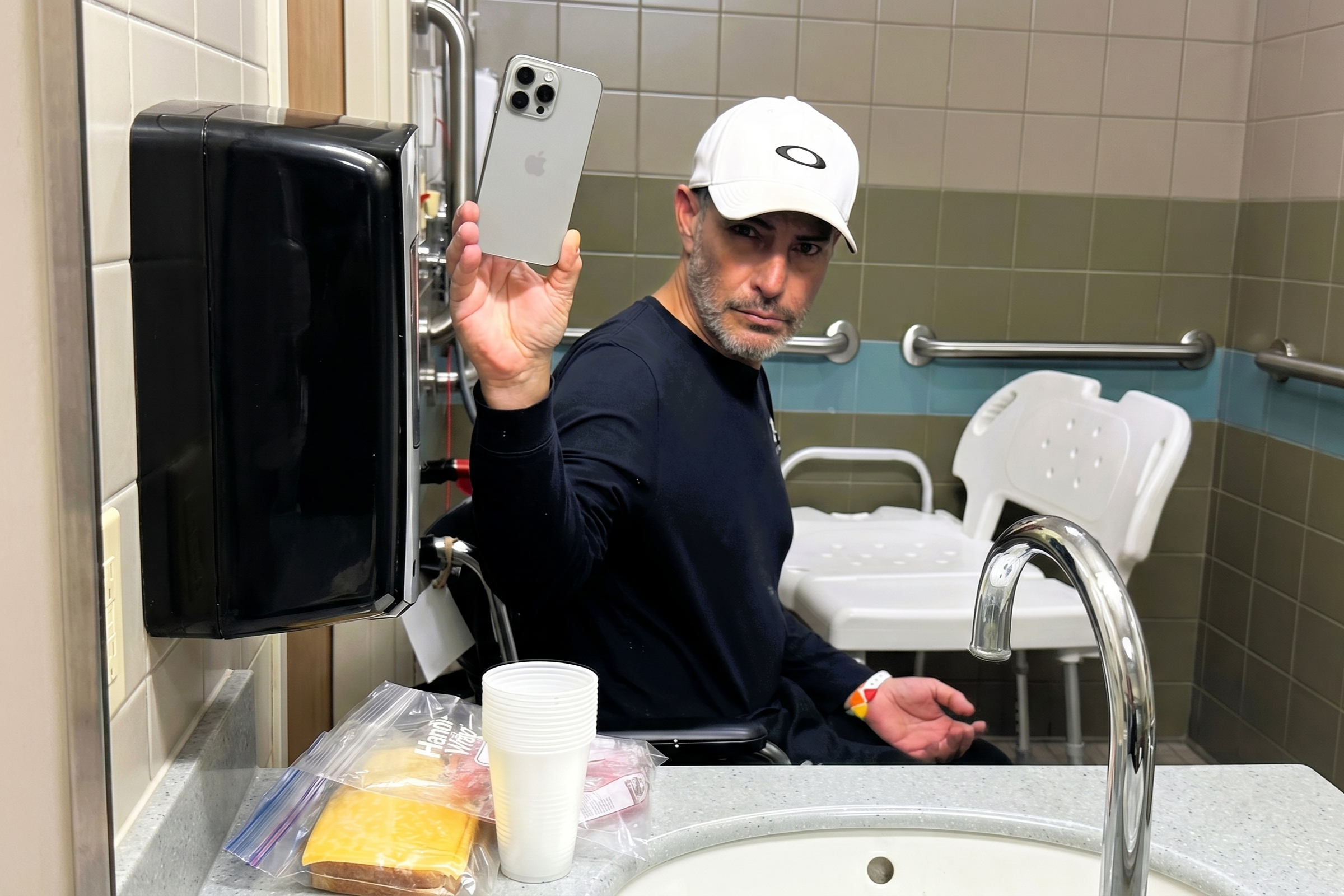
This image comes from a period of rehabilitation.
I am in an accessible bathroom, seated, with medical equipment and a shower chair around me.
There is nothing glamorous about the setting.
That is why it belongs with this story.
Trauma is not always dramatic after the event itself.
Sometimes it looks like trying to rebuild ordinary life.
Trying to take care of yourself again.
Trying to trust your body again.
Trying to recognize that the person in the mirror is still worth caring for.
PTSD made me keep returning to the worst moment
For years, part of me kept trying to solve the traumatic memory.
If I thought about it one more time, maybe I would understand it.
If I explained it more clearly, maybe someone else would finally understand what it felt like.
If somebody truly understood, maybe I would feel less alone.
But every attempt to make another person fully experience the memory required me to enter it again myself.
I eventually saw the cost of that.
I was asking people for something impossible
The people who cared about me could listen.
They could believe me.
They could understand that it was traumatic.
They could recognize that I was hurting.
But they could not become me in that room.
They could not experience my exact memory.
They could not feel precisely what I felt while trying to save Dawne.
And I finally understood that they did not need to.
My experience did not become legitimate only after somebody else understood every detail.
Then one sentence changed things
Eventually I found a simpler way to speak about it.
I could say:
I wish I had never seen that. I wish I had never had to experience that.
And stop.
No additional explanation.
No recreation.
No attempt to bring somebody else inside the memory.
No argument about whether I was allowed to feel the way I felt.
Just the truth.
I wish I had not seen it.
I wish I had not experienced it.
That became enough.
There was freedom in leaving the sentence alone
For years, the sentence always seemed to need another paragraph behind it.
I wish I had not seen it because...
I wish you understood because...
You would understand if you had been there because...
I stopped doing that.
The experience did not need to go on trial.
I did not need to prove that it had been traumatic.
I was there.
I knew.
That was enough.
I stopped trying to make other people carry it
This may have been the deepest change.
I once wanted people to understand so badly that I wanted them, emotionally, to carry part of it with me.
Now I do not want that.
I would not wish those memories on anyone.
I do not need somebody else to hurt in order for my pain to matter.
I do not need another person to see what I saw.
I do not need them to imagine every detail.
They can simply believe me when I say it was terrible.
They can simply understand that I wish it had never happened.
Compassion is enough.
Peace did not come from forgetting
I still remember.
Peace was never about erasing the memory.
It was about changing my relationship with it.
The memory stopped being something I had to solve every time it appeared.
I could acknowledge it.
Yes, that happened.
Yes, I wish it had not.
And then I could return to where I actually was.
That sounds small.
For me, it was enormous.
I learned that Dawne was larger than the way I lost her
This became one of the most important parts of healing.
Dawne's life was larger than her death.
Our relationship was larger than its ending.
One terrible period does not get ownership of every memory that came before it.
I do not want the traumatic images to be the first thing that represents Dawne in my mind.
I want room for everything else.
Her smile.
Her personality.
The places we went.
The ordinary conversations.
The photographs.
The laughter.
The private moments nobody else knew about.
The life.
That is who I lost.
Self-care became a form of respect
After the stroke, I eventually had to face something I had avoided for too long.
I was still alive.
That meant my life still required care.
Eating mattered.
Movement mattered.
Rehabilitation mattered.
Sleep mattered.
Medical care mattered.
Hope mattered.
I mattered.
Learning that again was not selfish.
It was necessary.
I began finding faith differently
My faith did not return because every question was answered.
Some questions remain unanswered.
I stopped requiring God, life, or the universe to explain every painful thing before I allowed myself to believe that love and meaning still existed.
I began finding faith in smaller places.
In survival.
In kindness.
In recovery.
In people who stayed.
In the ability to keep moving forward after believing I could not.
Hope came back quietly too
Hope did not return as some dramatic revelation.
It appeared in ordinary ways.
Planning something.
Looking forward to something.
Caring about my health.
Wanting to walk farther.
Wanting to get stronger.
Wanting tomorrow to be better than today.
At some point I realized I was participating in my own future again.
That was hope.
Inner peace is not the same as being okay with what happened
I am not okay with losing Dawne.
I am not okay with what I witnessed.
I am not thankful for the trauma.
I do not believe suffering automatically becomes valuable simply because a person survives it.
But I am at peace with the fact that I cannot change what happened.
There is a difference.
Peace means I no longer spend every ounce of energy demanding that the past become different.
It means I can acknowledge the truth without living inside the event.
I wish I had never seen it
That remains true.
I wish I had not been forced to witness what I witnessed.
I wish I had not endured those moments.
I wish I had never known what it felt like to desperately try to save the person I loved and still lose her.
I do not have to turn that into a lesson.
I do not have to make it beautiful.
I do not have to explain it until everyone understands.
I can simply say:
I wish I had never experienced that.
And leave it there.
That is where I found peace
Not by forgetting.
Not by denying.
Not by convincing everyone else.
Not by pretending I had not been changed.
I found peace by allowing the truth to be enough.
I loved Dawne.
I lost her.
I tried to save her.
I experienced things I wish I had never seen.
The trauma affected my mind, my body, my faith, my hope, my self-worth, and the way I cared for myself.
I lost more than 100 pounds.
I lived through denial and despair.
Later, I suffered a stroke and had to begin rebuilding parts of my life again.
None of those things disappeared simply because I learned how to speak about them differently.
But they stopped requiring me to prove their weight to everyone around me.
That burden is one I finally put down.
I am still here
The photograph with this story reminds me of a period when that simple fact carried enormous meaning.
I am still here.
Changed.
Scarred.
Missing someone I will always love.
Living with memories I would rather not have.
Living with the effects of a stroke.
But still here.
I no longer need everyone to understand exactly what I endured.
I only need to be honest about it.
I wish I had never seen it.
I wish I had never experienced it.
That is true.
And today I can leave the sentence there.
For me, that is part of what peace looks like.
This is my personal account of traumatic loss, grief, PTSD, declining self-care, and recovery after a stroke. I am describing the sequence of events in my own life, not claiming that PTSD or grief alone caused my stroke. Trauma and PTSD can have serious effects on daily life, and professional mental-health and medical care can be important parts of recovery.