I Wish I Hadn't Seen It: PTSD, Grief, and Learning to Live With What Happened
By Joey Montes · September 20, 2026
There are things in life you wish you could unsee.
Not because you are trying to deny that they happened.
Not because you are unwilling to face reality.
But because some moments were never meant to become permanent pictures inside your mind.
For me, losing Dawne was not only the loss of someone I loved. There was also the trauma surrounding how I lost her and what I experienced while desperately trying to resuscitate her.
Those are two different wounds.
There is grief because she died.
And there is trauma because of what I saw, what I experienced, and what I had to do in those moments.
For a long time, I did not know how to separate them.
The part I wish I had never seen
There are memories from that experience I would willingly give back.
I do not need them to prove that I loved Dawne.
I do not need them to remember her.
I do not need them to understand that her death changed me.
If I had been given a choice, I would not have chosen to see what I saw or experience what I experienced.
For years, even saying that felt complicated.
I thought maybe I had to do something more with the memory.
Understand it.
Explain it.
Make sense of it.
Find the correct words for it.
Make another person understand exactly how it felt.
Eventually, I discovered something much simpler.
I wish I had not seen that. I wish I had not experienced that.
That sentence does not need an argument behind it.
It does not need a defense.
It can simply be true.
Grief and trauma are not the same thing
I can remember Dawne with love.
I can smile at photographs.
I can remember conversations, ordinary days, laughter, places we went, and the countless details that made our life together ours.
Those memories belong to grief, love, and remembrance.
The traumatic memories are different.
They are not memories I cherish.
They are not memories I want to preserve.
They came from the circumstances surrounding her death and from trying to save her.
That distinction became important to me.
I realized I did not have to treat the worst moment of Dawne's life as the defining memory of Dawne.
Her death was a moment.
Her life was much larger.
PTSD can keep the moment from feeling finished
One of the difficult parts of PTSD is that the mind does not always file a traumatic experience neatly into the past.
You can know intellectually that something happened years ago and still have parts of the memory arrive with the emotional force of something happening now.
A thought can appear unexpectedly.
An image can return.
A sound, place, feeling, or unrelated moment can open a door you were not trying to walk through.
The event is over.
But the nervous system does not always behave as though it is over.
That was one of the hardest things for me to understand.
I was not choosing to keep revisiting it.
Sometimes the experience revisited me.
I wanted people to understand
For a long time, there was another burden attached to all of this.
I wanted people to understand.
Not merely understand the words.
I wanted them to understand what the experience actually felt like.
I wanted someone to comprehend the weight of being there, trying to change an outcome I could not change.
I wanted them to understand the difference between hearing that someone died and being physically present inside the worst moments of that loss.
That desire made sense to me.
Trauma can feel isolating.
You walk around knowing something happened that most people around you did not see.
They may care deeply.
They may listen carefully.
They may love you.
But they were not there.
I was asking for something they could not completely give me
Eventually, I began to see the problem.
No matter how carefully I explained it, another person could not actually experience my memory.
They could understand the story.
They could understand that it hurt.
They could understand that it was traumatic.
But they could not become me in that moment.
And the more I tried to make someone understand it exactly, the more I sometimes found myself returning to the experience myself.
I was carrying the trauma back into the room in an effort to prove the weight of it.
That realization changed something for me.
I stopped needing witnesses to my memory
I already knew what happened.
I already knew what I saw.
I already knew what I tried to do.
I already knew what it cost me emotionally.
The truth did not become more true because another person understood every detail.
My pain did not require a jury.
My trauma did not require outside certification.
I did not need to recreate the experience inside someone else in order for my own experience to be legitimate.
I stopped trying to make other people stand inside the memory with me.
They could care without seeing what I saw.
They could love me without feeling what I felt.
They could understand enough.
“I wish I hadn't seen it” became enough
This sounds almost too simple.
For me, it was not.
There was freedom in allowing myself to say:
I wish I had not seen that.
I wish I had not experienced that.
And then leaving the sentence there.
I did not have to follow it with an explanation.
I did not have to describe the scene again.
I did not have to justify why it affected me.
I did not have to convince anyone that it was bad enough to leave a mark.
I knew.
That was enough.
Acceptance is not approval
There is an important difference between accepting that something happened and being okay with what happened.
I am not glad I experienced those moments.
I do not believe I needed to experience them in order to become stronger.
I do not romanticize trauma.
If I could remove those particular memories while keeping every good memory of Dawne, I would.
Acceptance simply means I stopped demanding that reality become something different before I allowed myself to live.
It happened.
I hate that it happened.
I wish I had not seen it.
All three statements can coexist.
I stopped trying to solve the memory
For a long time, I treated the memory almost like a problem that could eventually be solved if I thought about it enough.
Maybe there was one more explanation.
One more angle.
One more detail I needed to understand.
One more conversation that would finally make everything settle.
But some experiences do not have an intellectual solution.
You can understand what happened and still wish it had never happened.
You can know the facts and still hurt.
You can replay something a thousand times without finding a version of it that becomes acceptable.
I had to stop asking the memory to give me something it could not give me.
The stroke complicated everything
Later, I also had to deal with a stroke and the changes that followed it.
That added another layer to the way I thought about memory, trauma, and identity.
A stroke can change the relationship you have with your own mind and body.
There were memory gaps and changes I had to navigate.
And yet some of the memories I would have gladly surrendered remained.
That irony was not lost on me.
There are things I wish I remembered better.
And there are things I wish I could forget.
Life does not always organize memory according to what we would choose.
I had to stop fighting what remained
The stroke taught me another version of the lesson grief had already been teaching me.
You can spend enormous energy fighting the fact that something is different.
Or you can acknowledge what is here and begin deciding how you will live with it.
That does not mean giving up.
It means directing energy toward the parts of life where you still have agency.
I could not make the traumatic memory disappear by force.
I could change the relationship I had with it.
The memory is not the whole story
This may be the most important thing I learned.
The moment I lost Dawne is part of my story.
It is not the entire story of Dawne.
It is not the entire story of us.
And it is not the entire story of me.
When trauma dominates memory, it can make one terrible period feel larger than all the years surrounding it.
I had to deliberately remember that Dawne existed before that day.
We existed before that day.
There was love before that day.
There was laughter.
There were ordinary mornings.
There were arguments, plans, private jokes, dinners, drives, conversations, and all the small things that make up a shared life.
I refuse to let the worst moment become the only monument to everything that came before it.
Peace came when I stopped asking the past to change
I used to think inner peace would arrive when I finally understood everything.
Instead, peace began when I accepted that there were some things I would never make okay.
I did not need to make them okay.
I needed to stop fighting myself because they were not okay.
That was different.
I could acknowledge the trauma without living inside it.
I could say I wished I had not experienced it without spending another hour describing why.
I could allow another person not to understand every detail.
I could let compassion be enough.
I no longer need anyone to feel it with me
This was perhaps the biggest change.
There was a time when I wanted people to understand by feeling some version of what I felt.
I no longer want that.
I would not wish that experience on anyone.
I do not need somebody else to hurt in order to validate that I hurt.
I do not need another person to visualize what I saw.
I do not need them to carry a copy of my memory.
They can simply hear me say:
It was traumatic. I wish I had never seen it.
And that can be the end of the explanation.
There is peace in not explaining everything
I used to think being understood required complete disclosure.
Now I think boundaries can be part of healing.
I am allowed to decide that a memory has already taken enough from me.
I do not owe it another performance.
I do not owe every listener every detail.
I can tell the truth without reopening the entire scene.
I can say what happened changed me.
I can say I live with PTSD from it.
I can say I wish I had not witnessed it.
Then I can stop.
There is dignity in that.
Remembering Dawne differently
I would rather remember Dawne through the life we shared than through the circumstances of her death.
That does not mean I deny what happened.
It means I refuse to give the traumatic memory ownership of every other memory.
When I think of Dawne now, I try to give the better memories room to speak too.
The smile.
The conversations.
The ordinary moments.
The photographs.
The person she was before the worst day arrived.
Those memories deserve space.
What inner peace means to me
Inner peace does not mean the trauma vanished.
It does not mean I never think about it.
It does not mean I suddenly approve of what happened.
It means the memory no longer gets to demand an explanation from me every time it appears.
Sometimes I can simply recognize it.
Yes. That happened.
I wish it had not.
And then I can return to the present.
That is peace to me.
The photograph
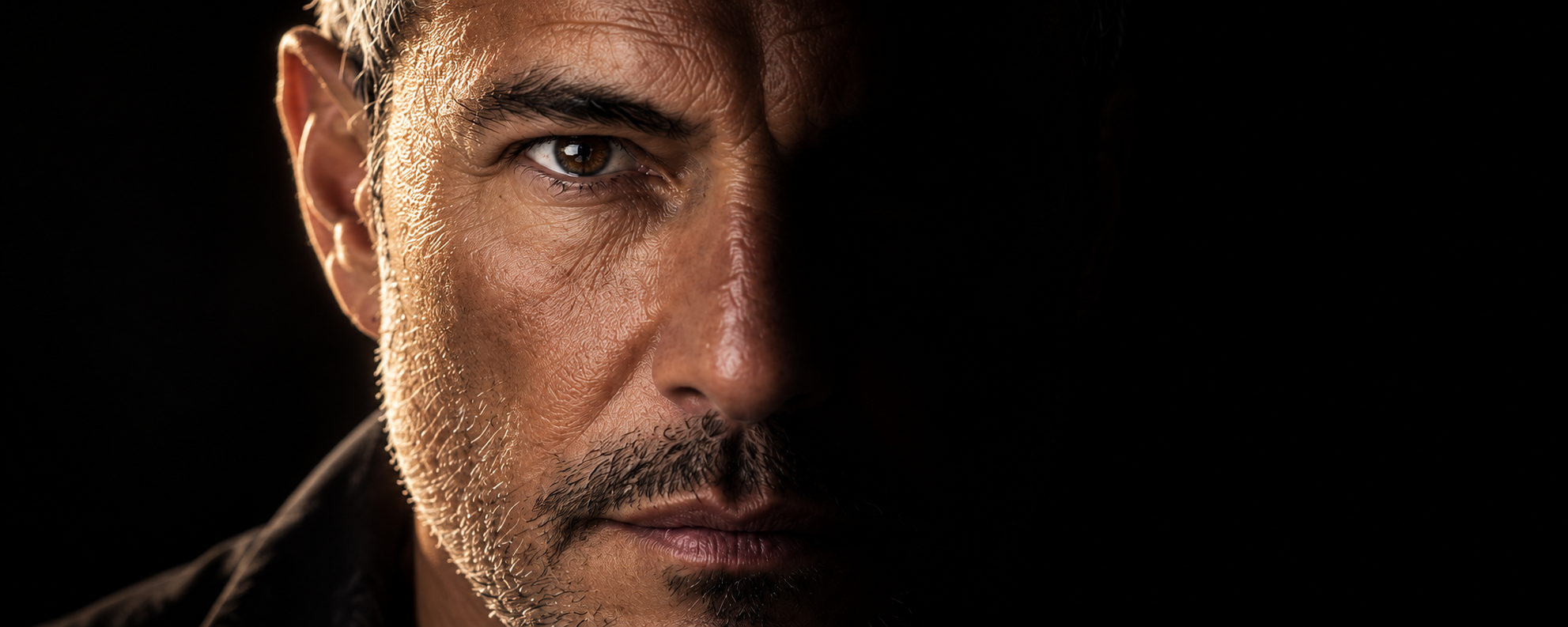
I chose this photograph because half of the face is illuminated and half disappears into darkness.
That feels appropriate.
There are parts of my story I can speak about openly.
There are parts that belong to the shadows.
I no longer believe every part has to be dragged into the light and examined repeatedly in order for me to heal.
Some things can simply be acknowledged.
They happened.
They hurt.
I wish they had not happened.
And I am still here.
I am no longer asking anyone to understand it perfectly
This may be where I finally found the most freedom.
I stopped expecting another human being to understand an experience they did not live through exactly as I understand it.
That expectation was impossible for both of us.
I do not need perfect understanding anymore.
I need honesty.
I need compassion.
I need the freedom to say, “I wish I had not seen that,” and know that the sentence is complete.
No defense.
No recreation.
No requirement that someone else experience the memory with me.
Just the truth.
I loved Dawne.
I lost her.
I tried desperately to save her.
What I experienced left a mark on me.
I wish I had never had to see or endure it.
And I have learned that I can leave the sentence there.
The memory belongs to the past.
The love does not.
And neither does my life.
This article describes my personal experience with grief, trauma, and PTSD. It is not intended to define how anyone else should process traumatic loss. PTSD can affect people in very different ways, and professional mental-health support can be an important part of recovery when traumatic memories, anxiety, sleep problems, avoidance, or other symptoms interfere with daily life.